PPC vs SEO: Which One Should Your Business Invest In First?
Introduction
Almost every business owner asks the same question eventually: should I put my budget into PPC vs SEO? Paid ads promise instant traffic. SEO promises traffic that keeps coming without paying for every click. Both are true and both come with trade-offs most agencies don’t explain clearly enough.
Here’s an honest breakdown of how each one actually works, so you can decide where to put your next dollar with confidence, not guesswork.
What PPC Actually Does
PPC (pay-per-click) puts your business at the top of search results immediately as soon as your campaign goes live, you’re visible. You pay for every click, and the moment you stop paying, that visibility disappears.
PPC is strongest when you need results fast: a launch, a seasonal promotion, or testing which offers and messaging actually convert before scaling further.
What SEO Actually Does
SEO (search engine optimization) is the slower, compounding path. Instead of paying for each visit, you’re building organic visibility that keeps working long after the initial effort through content that actually moves the needle, technical optimization, and consistent authority-building.
It typically takes months to see meaningful results, but unlike PPC, that traffic doesn’t stop the moment you pause spending on it.
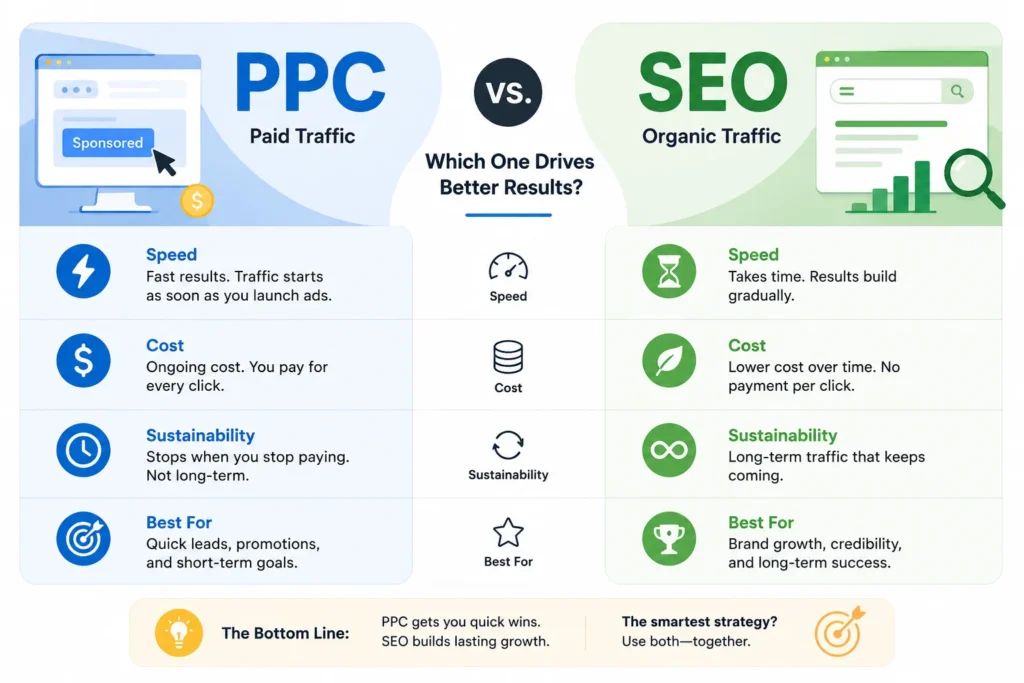
PPC vs SEO: Speed, Cost, and Longevity Compared
| Factor | PPC | SEO |
| Speed to results | Immediate | 3–6 months |
| Cost structure | Pay per click, ongoing | Upfront effort, lower ongoing cost |
| Longevity | Stops when budget stops | Keeps working over time |
| Best for | Launches, promotions, testing offers | Long-term, sustainable growth |
| Trust factor | Users know it’s an ad | Organic results feel more credible |
When PPC Makes More Sense
- You’re launching something new and need visibility now
- You want to test which messaging or offer actually converts before investing further
- You’re running a time-sensitive promotion
- Your funnel is already built and ready to convert paid traffic efficiently
When SEO Makes More Sense
- You’re building for the long term, not just this quarter
- You want traffic that doesn’t disappear the moment your budget does
- You’re targeting local customers searching nearby — Local SEO especially compounds well over time
- Your current website is fast and set up to convert the organic traffic you’ll eventually earn
Why the Smartest Answer Is Usually Both
Most businesses treat this as an either/or decision, but the strongest results usually come from running both at once PPC for immediate visibility and data, SEO for the compounding growth that keeps paying off long after.
PPC data (which keywords convert, which offers perform) can directly inform your SEO content strategy, and SEO reduces your long-term dependency on ad spend as it builds. Together, they cover both today and the next two years.
Frequently Asked Questions
Which one gives a better return on investment?
It depends on your timeline. PPC gives faster, more predictable short-term ROI. SEO usually delivers a better ROI over 12+ months, since the traffic keeps coming without paying per click.
Can I run both PPC and SEO at the same time?
Yes, and it’s usually the smartest approach. PPC can fund quick wins while SEO builds in the background, and each strategy’s data can improve the other.
How much budget do I need to start with PPC?
It varies heavily by industry and competition, but starting with a smaller test budget to validate what converts before scaling spend is almost always the safer approach.
Is SEO still worth it if my competitors are only running ads?
Often, yes that gap is an opportunity. If competitors rely solely on paid ads, ranking organically can let you capture customers without bidding against them for every single click.
Final Thought
There’s no universal winner in the PPC vs SEO debate — the right choice depends on your timeline, budget, and goals. Most businesses that grow steadily end up using both, just with different weight depending on where they are right now.
If you want an honest recommendation on where your budget should go first, get in touch with our team it’s exactly the kind of strategy work we do every day.
HELLO! WE'RE LISTENING
Let's talk about your project your idea your vision
Services
- Social Media Marketing
- Digital Consultancy
- Email Marketing
- Link Generation
- Online Presence Analysis
Company
- Our Team
- About Us
- Contact Us
Support
- Help Center
- Get Live Support
- view documentation
Copyright © 2026softRawe
- Term of use
- Privacy Policy